
Black Water Night Diving in Kona: Encountering the Deep-Sea Pelagic World
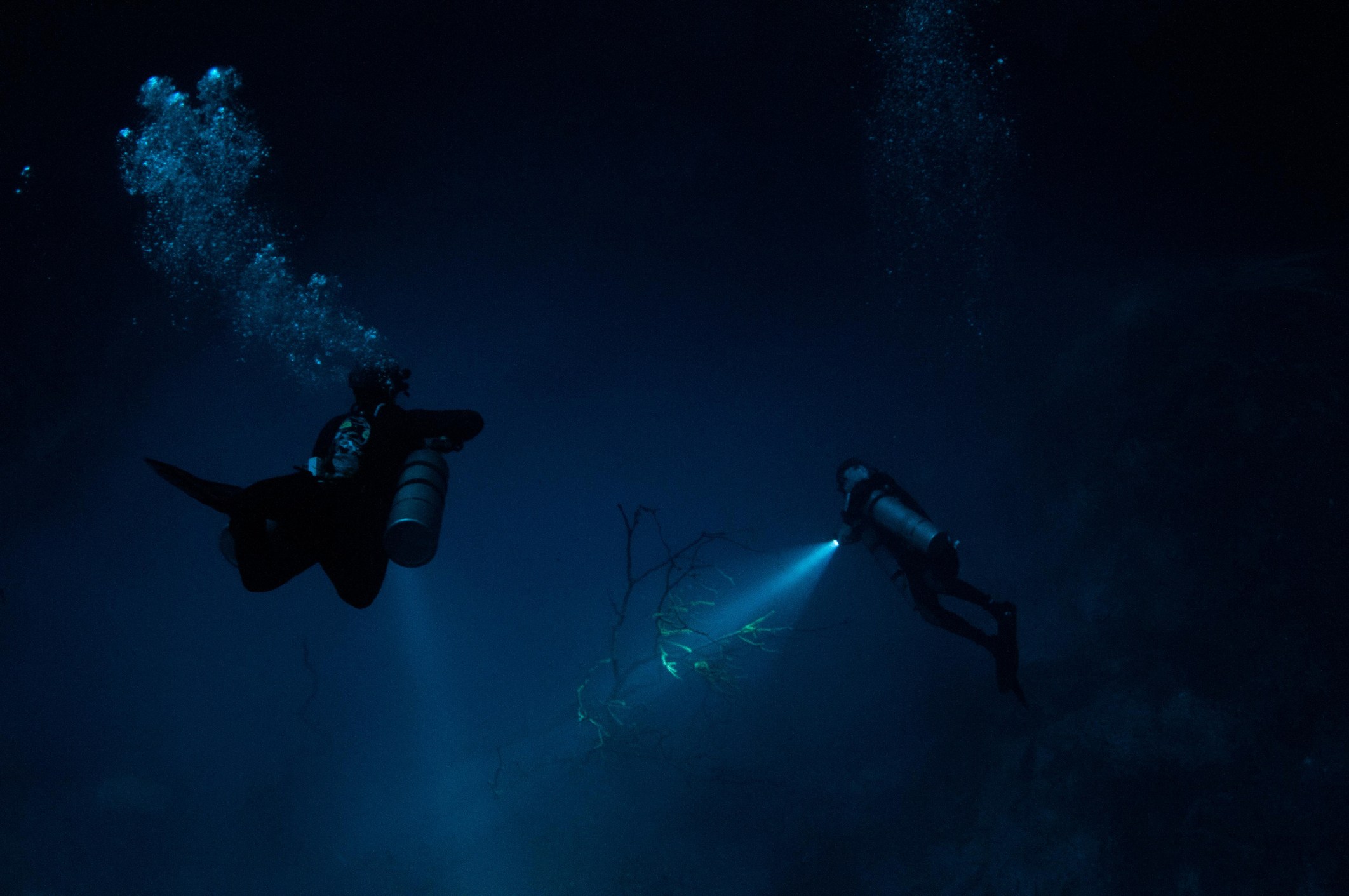
A few miles off Kona, the seafloor is more than 3,000 feet down, and after dark the animals that live in that water rise to meet the lights. You clip onto a line. You hang at fifty feet over nothing at all. What drifts past in the next hour looks less like fish and more like something a glassblower dreamed up on a strange night.
Blackwater diving is the oddest hour in recreational scuba. It is also the easiest to get wrong, which is why the briefing matters more than the gear.
Quick Summary: Key Takeaways
- Over 3,000 feet of water: the boat runs offshore past the drop-off, and divers hang on a lit downline at 40 to 60 feet.
- Everyone is tethered: the line is your only visual reference in black water, and it is what keeps your depth honest.
- Diel vertical migration: the nightly rise of deep-sea life is the entire reason the dive works at all.
- Mostly larval animals: paper nautilus, pelagic octopus, siphonophores, and glass-clear larval eels, small and hard to name.
- Buoyancy before bravado: advanced certification plus recent dives, and do a manta or day dive first if your trim is rusty.
A black water dive suspends you over thousands of feet of open ocean
There is no bottom. The boat runs out past the drop-off, sets a weighted downline hung with bright lights every few feet, and divers descend that line to somewhere between 40 and 60 feet with nothing but black water underneath them.
The lights do the work. They pull in plankton, the plankton pull in everything that eats plankton, and within twenty minutes the column around the line is a slow parade of larval fish, drifting jellies, and animals nobody on the boat can name with any confidence.
→ pelagic black water night dive
The tether and the lights are the entire safety system
Buoyancy is everything here. Every diver is clipped to a line, and that single rule is what makes a dive over 3,000 feet of water reasonable, because without a visual reference in blackwater, the word up becomes a guess.
Depth creep is the real hazard. Not sharks, not the dark, just a slow unnoticed sink while you are focused through a macro lens, which is why the crew watches gauges and light positions from above for the whole dive.
→ meet our captains and dive crew
Every night the deep ocean rises to meet you
This dive exists because of diel vertical migration, which NOAA calls the largest animal migration on Earth, and it happens every single night as deep-sea life climbs hundreds of meters toward the surface to feed.
Then it all goes back down. Larval eels like ribbons of glass, siphonophores stretched out like strings of Christmas lights, pelagic octopus the size of a thumbnail, salps chained together a meter long, all of it heading for the deep again before sunrise.
The animals are small, strange, and mostly larval
The site moves nightly. Almost nothing you see will be an adult animal, because fish larvae, cephalopod paralarvae, and juvenile crustaceans make up most of the traffic, and that is precisely why underwater photographers fly to Kona for this one dive.
The paper nautilus is a favorite. So is the blanket octopus. Neither is promised on any given night, which is the deal you accept with a dive site that drifts somewhere new every evening.
This dive asks for control rather than depth experience
Come back later if you need to. Advanced certification, recent dives, and an honest self-assessment are the requirements, and if your buoyancy is still a work in progress, you will get far more out of a manta dive or a two-tank day dive first.
Bring a focus light and a backup. Warm layers help too, because you hang nearly motionless for close to an hour, and water off Kona sitting around 80 degrees in August feels cooler than that when you are not swimming.
Frequently Asked Questions
Q: What is a black water dive?
A: A night dive in the open ocean over very deep water. Divers clip onto a lit, weighted line hung below the boat and hover at 40 to 60 feet while deep-sea animals rise past on their nightly migration toward the surface.
Q: How deep do you go on a Kona black water night dive?
A: Usually 40 to 60 feet, even though the seafloor is thousands of feet below. Depth control is the entire skill, so the tether and the crew watching from the boat keep everyone at the planned level.
Q: Is black water diving dangerous?
A: It is managed, not casual. The tether, the lights, and a hard depth limit remove the main risks, which are disorientation and unnoticed descent. Divers need advanced certification, current experience, and steady buoyancy.
Q: What will I see on a black water dive in Kona?
A: Larval fish and eels, siphonophores, salps, jellies, pelagic octopus, and sometimes a paper nautilus. Almost everything is small, translucent, and juvenile. No two nights produce the same list of animals.
Book a black water night dive with a crew that runs them often
Tell us your certification level and roughly how many dives you have logged this year. We will tell you straight whether this is the right week for it, or which trip to do first.
Kona Ocean Adventures — Kealakehe Pkwy, Kailua-Kona, HI 96740 (Honokohau Harbor)
Hours: Daily, 7:00 AM to 11:00 PM; departures vary by tour
Website: konaoceanadventures.com